
Issue: In 2023, Oakville Council passed a motion to adopt the policy that green infrastructure be preferred, and grey infrastructure only where necessary, with a program of public consultation.
The problem is that we are not living up to that commitment. Every renewal project we undertake should be based on green infrastructure and every new project should reflect the latest advances. Other communities are leading the way in employing leading edge stormwater solutions - Oakville lags behind.
In areas of heavier density, such as our most northern Ward 7 where new development is ongoing on a large scale, the Town of Oakville has adopted the use of stormwater management ponds. The latest advice from experts is to only use stormwater management ponds as a last resort.
It is crucial that the Town of Oakville adopt more advanced "treatment train" systems to meet the need to reduce quantity of runoff entering our water bodies and the challenge of ensuring this runoff is as clean as possible.
What is Green Infrastructure?
Historically, communities have used gray infrastructure—systems of gutters, pipes, and tunnels—to move stormwater away from where we live to treatment plants or straight to local water bodies. Oakville is no different. The gray infrastructure in many areas is aging, and its existing capacity to manage large volumes of stormwater is decreasing.
Runoff from stormwater is growing as a major concern for governments as well as residents.
-
It is a cause of water pollution in urban areas because it carries trash, bacteria, heavy metals, and other pollutants through storm sewers and deposits them into local waterways like Oakville's 16-Mile 14-Mile Creek, Twelve Mile Creek and eventually, Lake Ontario.
-
A second concern is that heavy rainstorms can cause flooding that damages both property and infrastructure. Increasing severity of storms has resulted in a mounting number of insurance claims.
To meet these challenges, many communities are installing green infrastructure systems to bolster their capacity to manage stormwater. By doing so, communities are becoming more resilient and achieving environmental, social and economic benefits.
How Green Infrastructure Works
Basically, green infrastructure filters and absorbs stormwater where it falls. This is sometimes called "Catch and Clean".
-
Green infrastructure is "the range of measures that use plant or soil systems, permeable pavement or other permeable surfaces or substrates, stormwater harvest and reuse, or landscaping to store, infiltrate, or evapotranspirate stormwater and reduce flows to sewer systems or to surface waters."
Green infrastructure elements can be woven into a community at several scales.
-
At home, small scale examples are things like a rain barrel to catch roof runoff, a rain garden, a driveway made with permeable pavement, planting of native grasses in areas where erosion is a danger or disconnecting downspouts and weeping tiles from the municipal sewer.
-
Neighbourhood scale green infrastructure could include acres of open park space outside the centre of a city, planting rain gardens or constructing a wetland near a residential housing complex.
At the landscape or watershed scale, examples could include protecting large open natural spaces, riparian areas, wetlands or greening steep hillsides.
When green infrastructure systems are installed throughout a community, city or across a regional watershed, they can provide cleaner air and water as well as significant value for the community with flood protection, diverse habitat, and beautiful green spaces.
Examples of Green Infrastructure

A 'roadside bioswale' takes runoff from the roadway, directs it to a bioswale of grasses, plants and trees.

Municipal rain garden to accept stormwater road runoff. The rain garden acts as a sponge, slows the runoff rate and cleans the stormwater as it enters the stormsewer system.
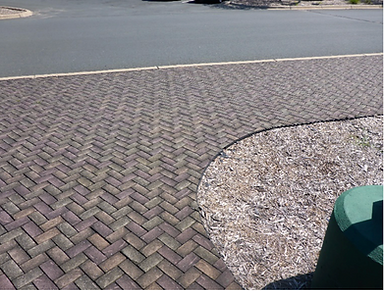
Types of permeable surfaces available for parking lots, driveways, outdoor recreation areas, etc.
Stormwater Ponds Aren't Enough
While new subdivisions being built now include stormwater management ponds, there's much more to do. Stormwater ponds are 'end-of-pipe' solutions that require dedicating large parcel lots purely for water retention.
These ponds can pose safety/drowning hazards and often sometimes require chain-link fencing. As well, stormwater management ponds rely on gravity settling (sedimentation), leaving dissolved toxins in open water.
rain gardens could be incorporated into road designs to lessen the amount of stormwater and improve the quality of moving to the ponds.
At present in Oakville, there are OVER 50 stormwater management ponds and additional sites are in the pipeline. This isn't sustainable. It needs to change.

"Like other end-of-pipe practices, stormwater management ponds should be used only as a last resort, after all other upstream opportunities for source controls and infiltration have been fully employed."
Sustainable Technologies
Designing an entire subdivision around Low Impact Development (LID) marks a paradigm shift from traditional "end-of-pipe" systems (like massive, fenced-off stormwater ponds) to a "treatment train" approach. This method manages, absorbs, and filters rainwater right where it falls across every single lot and roadway. Stormwater management ponds (SMP) are not a complete environmental solution because they are industrial flood-control tools rather than natural, self-sustaining ecosystems.
Problems With SMPs:
Rate vs. Volume: Ponds only slow down how fast water enters local streams; they do not reduce the total volume of runoff. They fail to restore natural water absorption patterns.
Unsafe for Play: These pools look like natural lakes, but they are strictly industrial infrastructure. Dangerous Ice and Water: Water flows in and out constantly. This creates thin ice, strong hidden currents, and sudden water level changes that make swimming, fishing, and skating extremely dangerous.
Chemical Contaminants: The water collects heavy metals, bacteria, and road salt from nearby streets and parking lots.
Poor Wetland Replacements: Research shows that relying on artificial ponds to replace or restore natural wetlands is not sustainable. Small, vital natural wetlands continue to disappear while artificial ponds fail to provide the same biodiversity benefits.
RainGarden
In Right of Way

Designed to capture, clean and absorb stormwater runoff while reducing flooding.
Rain water runoff is collected from paved and other hard surfaces (driveways, roadways, roofs) and directed into this garden.
-
Mulch and plants absorb water and nutrients from the stormwater and provide beautiful habitat for native birds and insects.
-
Water slowly seeps through a special mixture of sand and organic material that absorbs and filters out pollutants.
-
The gravel layer below the soil stores the clean stormwater and allows this water to filter into the ground to recharge the groundwater.
-
Treated stormwater that does not filter into the ground is drained into the storm sewer through a subdrain.
Solutions Needed
-
Low impact development (LID) must become Oakville's method of choice for each and every stormwater solution. That includes our new subdivisions in northern Oakville. It is now possible to build entire housing developments that are equipped to allow stormwater runoff to be managed through a variety of low impact development features, based on a treatment train-approach that provide enhanced water quality and quantity treatment. These include the combination of permeable paver driveways, rain gardens, infiltration trenches, oil and grit separators, and bioswales. The Wychwood subdivision in Brampton is one example.
-
Repaving projects of Town-owned properties such as parking areas, multi-use paths, etc, need to be undertaken with permeable pavement.
-
Oakville must commit to allocating funding from the newly-established Stormwater Management Fee to be directed specifically to LID, green infrastructure, and the discontinuation of stormwater management ponds in favour of the alternatives that are now available.
-
Areas within the Town that still retain natural drainage (open ditches) must be maintained, rehabilitated and enhanced with LID.