
Issue: The Midtown Oakville Transit Oriented Community (TOC) being imposed on Oakville via the provincial Minister's Zoning Orders will affect ALL of Oakville. It is the largest overdevelopment threat we have ever faced as a town.
If this level of development in Midtown is allowed to proceed, the results will be ruinous for all of Oakville
-
Gridlock on Trafalgar Road, QEW interchanges, Cornwall Road, Cross Avenue and others.
-
Thousands of people stuck in a wasteland with no liveability without schools, parks, emergency services or a host of other needs for daily life.
-
Overloading on other areas and streets throughout Town that will be called on to provide these missing services to those who will need them - think schools, parks, community services, shopping for essentials, etc.
-
Your tax bill will have to pay for a new city in the middle of Oakville. A hyper-density Midtown will have needs for services and Infrastructure will not be covered by the developers. The shortfall will be significant to support a community of this size and it will fall on ALL Oakville taxpayers
What Are We Facing?
The Transit Oriented Community (TOC) plan for Midtown Oakville is, first and foremost, a Provincially designed and driven program. That's important to remember. Here's why ...
-
Oakville Town Council has no power to refuse the TOC in the same way it might a normal development application.
-
Council's power has been usurped by the Province. That means our Livable Oakville Official Plan is moot. The Province's TOC and its Minister's Zoning Order supersede it.
-
The developer partner working with the Province was selected by the Province, with no involvement by Oakville Town Council or Oakville's Planning Staff.
-
Like so many of the Province's other programs we're hearing about in the news, the selection of the developer to undertake the construction of the Midtown TOC was a back room deal.
-
For more than a year, Council has been subject to a Non-Disclosure Agreement imposed by the Province, (a gag order) which has tightly limited the information Council could share with the general public - residents of Oakville

What Happened In March 2026?
Why did the agenda for an in-camera meeting include the matter being considered included "a proposed or pending acquisition or disposition of land by the municipality"
and...
"a position, plan, procedure, criteria or instruction to be applied to any negotiations carried on or to be carried on by or on behalf of the municipality"
At its March 23, 2026 Planning & Development Meeting, Council found a late addition to its agenda:
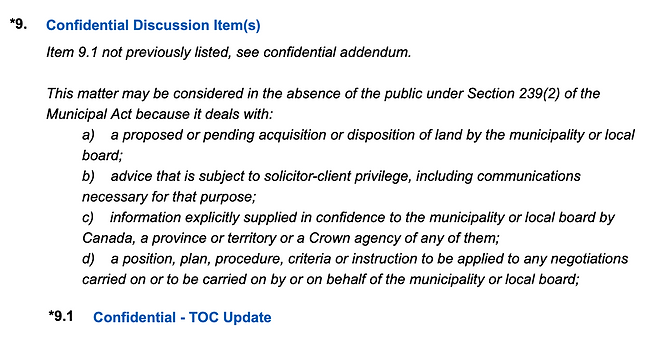
In the post-meeting minutes, this item was described as: "a report from the Office of the Mayor" which contained a "confidential direction" At 7:30 p.m. Council resolved into closed session.
Approximately 90 minutes after entering the in-camera meeting, Council returned to hold a public vote on this undisclosed “confidential direction”.
Moved by Councillor Adams
Seconded by Councillor Lishchyna
That the confidential direction provided in the report from the Office of the Mayor dated March 20, 2026 be approved.
For (8) Councillor Adams, Mayor Burton, Councillor Chisholm, Councillor Grant, Councillor Knoll, Councillor Lishchyna, Councillor Longo, and Councillor Xie
Against (6) Councillor Duddeck, Councillor Elgar, Councillor Gittings, Councillor Haslett-Theall, Councillor O'Meara, and Councillor McNeice
Absent (1) Councillor Nanda
Following the vote, Mayor Burton was asked when information on the decision would be made public. His stated as soon as the information could be made public, it would be. The general public was not given any information on this so-called “confidential direction,” however some surmised that Council was asked to approve a final proposed TOC and it was felt that if that was the case, the “confidential update” morphed into a vote on a final TOC proposal, taken without public notice, without input, and without any meaningful oversight.
The secrecy surrounding the process, combined with the concerns raised by those who voted against it, raised serious red flags.
In April, Oakville Is Hit with Minister's Zoning Orders on Midtown.
What Did The Press Release Say?
How Can You Reduce Building Heights But Still Retain The Same Number of Building Units?
On April 9th, Infrastructure Ontario published a News Release stating four Minister’s Zoning Orders (MZOs) had been issued for Midtown that would help deliver more than 6,800 new homes.
The MZO's provide permissions that match the "Revised Submission" on Midtown from November 25.
The four (4) MZOs made by the Minister of Infrastructure are for the Transit-Oriented Community in the Town of Oakville, which includes these lands, and would permit the development of:
Site 1: 3 mixed use buildings, 49, 52 and 56 storeys.
Site 2: 2 mixed-use buildings, 52 and 56 storeys.
Site 3: 3 mixed-use buildings, 49, 50 and 56 storeys.
Site 4: 3 mixed-use buildings, 45, 51 and 56 storeys.
The four (4) MZOs include exceptions to the requirements of the Town of Oakville’s Zoning By-law including, amongst other things, building height, setbacks, maximum lot coverage, density, dimensions of accessible parking, and any requirement for Inclusionary Zoning and community benefits.
Bottom Line: The 6,800+ units in 11 buildings ranging from 45 to 56 storeys had now been approved and no appeal is possible.
A Further Wrinkle
The press release that accompanied the Minister's Zoning Order included the following...
"In response to feedback received from the town and the community, Ontario is working with the municipality and impacted partners on further refinements to the Oakville TOC that will result in building heights of 38 storeys, while maintaining the overall number of homes and community benefits".
There are Important things to note regarding the above statement:
1. Note that Ontario says that while further refinements to the TOC will result in building heights of 38 storeys, it will maintain the overall number of homes, which is over 6,800.
Due to the dimensions of the TOC building site, It is impossible for the TOC developer, Distrikt Developments, to reduce building heights and accommodate the units it would need to relocate on the present site. We all know, when you compress an object vertically, it must expand or bulge outward horizontally.
2. It is probably not coincidental that mention of 38 storeys happens to match with comments made by Nav Canada when it reviewed Distrikt's required submission of its plans at Midtown. In December 2025, NAV Canada formally notified Distrikt that the project's planned towers—which reach up to 56–59 storeys under provincial Minister’s Zoning Orders (MZOs)—intrude into airspace protected by its Minimum Vectoring Altitude (780 feet above sea level), carrying file reference 25-5778. While NAV Canada does not legally set a maximum cap for buildings, its safety guidelines suggest that compliant development in the Midtown flight path would need to be significantly lower—potentially capping buildable space at roughly 35 to 38 storeys.
3. Given the fact the total number of 6,800+ units cannot be accommodated on the TOC site, an additional site must be found near the TOC development. Does this relate to the discussion at the In-Camera meeting of March 23, 2026 where the agenda made reference to the "disposition of land by the municipality?".
Look Closer at Midtown
Town-owned land in Midtown is limited. The illustration below reveals their locations. On the west side of Trafalgar Road, only two plots represent sufficiently sized pieces of developable lands. Plot A will be eliminated due to the fact it will be utilized in the widening of Cross Avenue. That leaves Plot B. In terms of development, Plot B also represents the last piece of publicly owned lands that could be utilized as green space to serve the high density community that Midtown's development applications are quickly revealing it to be.

What Came Next
Questions quickly surfaced regarding Ontario's statement of retaining the full 6,800+ units while also saying building heights would be 38 storeys. It was clear that outcome was not possible on the existing TOC development site.
At this juncture, Mayor Burton publicly made reference to the utilization of a 'density transfer' and in mid April he appeared on local YourTV's news cast where he advised he was involved in secret negotiations with the province. He further stated "the result is put in front of whoever has to approve it ... and the public finds out at the end".
What's Wrong With the TOC?
Industry leaders, Watson Associates Economists, forecast a total number of housing units in Midtown as 8,900 by 2051. At 6,880 units, the TOC represents an overwhelming portion of that total. That means it profoundly affects Midtown's future by concentrating risk, stressing public infrastructure and creating financial insecurity. Its dominance creates a higher-stakes scenario for Midtown, moving the risk from a diversified, incremental approach to one heavily dependent on a single entity.
Furthermore, N.Barry Lyon & Associates reported - Over the next decade NBLC expects that demand for residential uses in Midtown could be in the range of 200-300 units ANNUALLY. Based on that rate it will take 23 years to fill the TOC buildings alone. "At a time when markets are soft and investors unlikely to return soon, developers seem to be seeking building heights that defy logic".
-
GO transit and local bus routes do not drive demand to the same extent as subway service or LRT service as part of a wider local transit network
-
…notable for Midtown Oakville, the four comparable communities that are located in Halton Region (Aldershot, Appleby, Burlington, Milton) all have proposed building heights in development applications that are under 40-storeys, indicating their more modest market appeal relative to other more established nodes like MCC, VMC, and Markham Centre that can support much larger buildings.
The Province is not providing any meaningful upgrades such as new additions or other improvements to access the GO Station, express transit services or other assistance. In fact, the developer's own studies reveal that cars and buses will be frozen in heavy traffic trying to enter and exit the GO Station.

The size and scope of the TOC presents undeniably high risk to Midtown's future, the Town and Oakville's residents.
Consider these factors:
Economic Vulnerability - financial health and timeline for the entire Midtown area become tied to a single developer.
Market Distortion - the TOCs enormous needs sideline those of other developments.
Infrastructure Strain
Phasing & Coordination Issues
Loss of Incremental Growth - the TOC leaves no room for smaller, more appropriate sized developments that have a better chance of success, would reflect a more suitable style and character of housing for the area and offer the kind of housing young families and first time buyers are seeking.
No Public Records - none of the financial terms, risk assessments, benefits or other pertinent details of the TOC have ever been released to the public.
Inevitable property tax increases to pay for infrastructure and TOC associated costs that aren't covered by development charges.

If the TOC is allowed to develop to the level the Province is proposing, the results will be ruinous for ALL of Oakville.
TOTAL GRIDLOCK on Trafalgar Rd, the QEW Interchanges, Cornwall Road, Speers Road and the surrounding areas.
8-Minute Delays to Exit the QEW
Access to GO will get worse, not better. The developer's own reports show that cars and buses will be frozen in heavy traffic trying to enter and exit the GO Station.
The Province IS NOT providing any upgrades or other improvements that will speed up access/egress to and from the GO Station, nor is It investing in express transit services a bus rapid transit station or parking, express transit services.
AND …
The TOC will be incapable of providing the services and community supports residents will need. That means widespread effects across a host of areas like schools, retail, parks … and increased property taxes.